
Last Updated on August 24, 2026 by jparadiso
Valid Emails Going to Spam? Understanding the Reputation Gap in Email Deliverability
Even when an email has passed validation, it can still fail to reach the inbox and instead land in the spam folder, a phenomenon often overlooked in email marketing. This occurs due to a complex interplay of sender reputation, content quality, infrastructure configuration, and recipient engagement, factors that email validation tools alone cannot fully address. Effectively, the email is technically valid but practically undeliverable to the primary inbox.
What Does “Valid Email” Truly Mean, and Why Isn’t It Enough?
An email address is considered “valid” when it adheres to established technical standards and can receive mail. This typically means the domain exists, the mailbox exists at that domain, and the syntax of the address is correct. Email validation services, like Validify, check for these fundamental criteria, ensuring you’re not sending messages to non-existent addresses, misspelled domains, or temporary throwaway accounts. This crucial first step prevents immediate bounces, protects your sender reputation from hard bounce penalties, and saves you money by avoiding sending unnecessary emails.
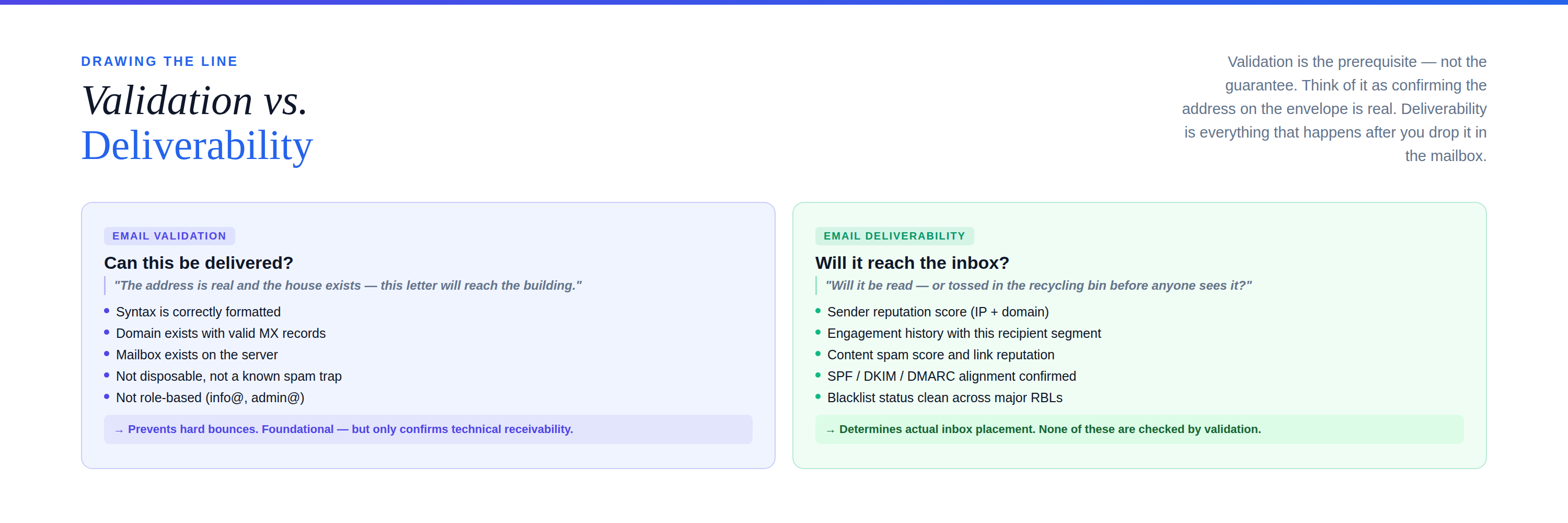
However, the concept of “validity” is purely technical. It confirms that an email can be delivered, not that it will be delivered to the recipient’s primary inbox. Think of it like mailing a letter: validation ensures the address is real and the house exists, but it doesn’t guarantee the letter won’t be mistaken for junk mail and tossed in the recycling bin before being read. The gap between technical validity and actual inbox placement is where the challenge of email deliverability truly lies, giving rise to the pervasive problem of valid emails going to spam.
The Core Components of Email Validation
Email validation involves several key checks to ascertain the viability of an email address:
- Syntax Check: Ensures the email address conforms to the standard
user@domain.comformat. Invalid characters, missing@symbols, or malformed domain names are flagged. - Domain Validation (DNS Check): Verifies that the domain name associated with the email address exists and has valid MX (Mail Exchange) records. This confirms the domain is set up to receive email.
- MX Record Check: Specifically looks for MX records, which tell sending mail servers where to route emails for a particular domain. Absence of MX records means emails cannot be received.
- Role-Based Email Detection: Identifies generic addresses like
info@,support@, oradmin@. While valid, these often lead to lower engagement and are sometimes filtered more aggressively. - Disposable Email Address (DEA) Detection: Flags temporary email addresses designed for short-term use, which are rarely engaged with and can inflate list sizes with unengaged contacts.
- Spam Trap Detection: Identifies email addresses that are purposefully set up to catch spammers. Sending to a spam trap can severely damage sender reputation.
- Greylisting/Mailbox Existence Check: Involves attempting a partial delivery or using specific SMTP commands to confirm if a mailbox truly exists on the server without fully sending an email. This is a critical step for accurately determining if an address will bounce.
These checks are paramount for maintaining a clean list and ensuring your foundational email infrastructure is sound. Yet, as robust as they are, they form only one piece of the complex deliverability puzzle. The subsequent sections will unpack why a perfectly validated email can still end up in the dreaded spam folder, leaving marketers scratching their heads and campaigns underperforming.
Why Do Valid Emails End Up in the Spam Folder Instead of the Inbox?
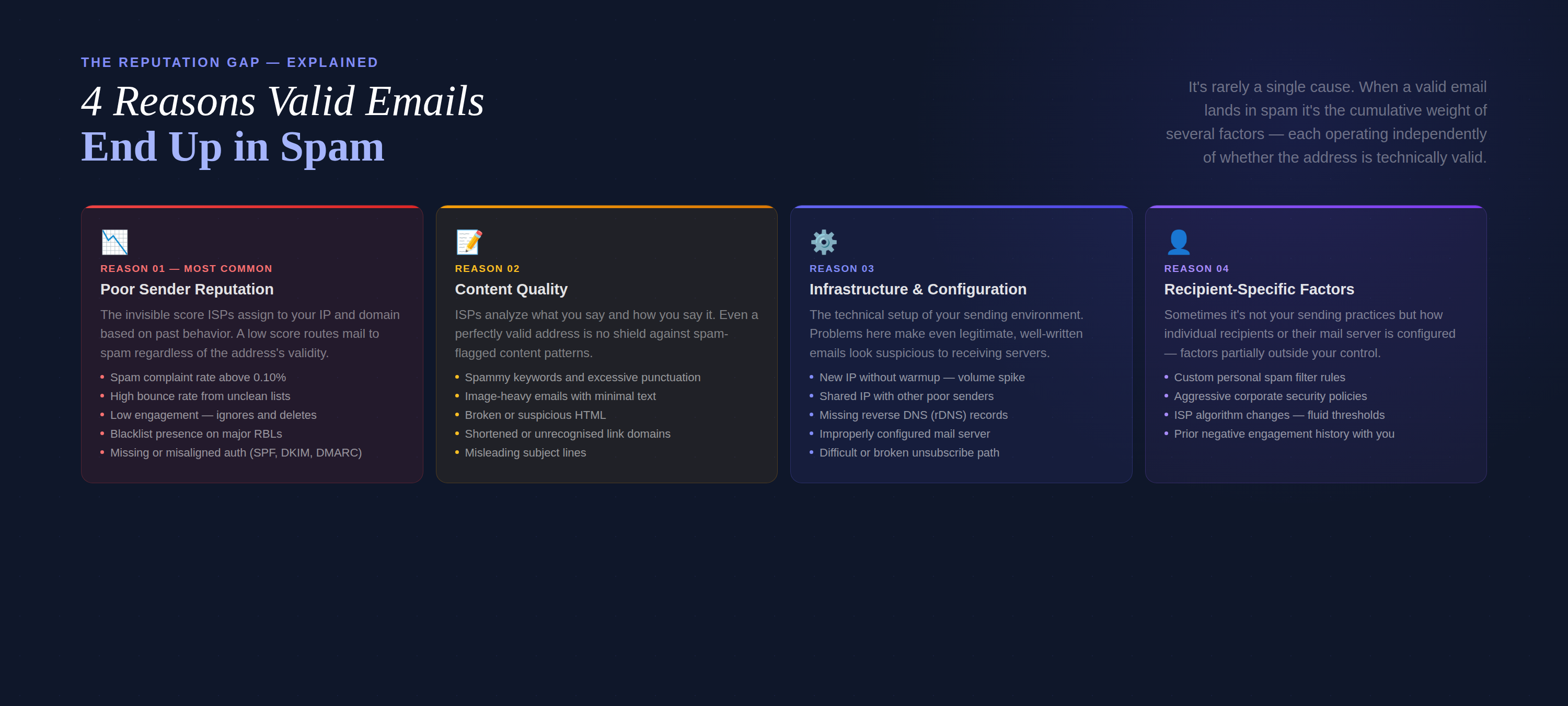
The journey of an email from sender to recipient’s inbox is fraught with potential pitfalls, even for seemingly valid messages. When valid emails go to spam, it’s rarely due to a single issue but rather a cumulative effect of various factors impacting sender reputation and email content. Understanding these reasons is crucial for effective email marketing and improving inbox placement.
1. Sender Reputation: The Invisible Score That Dictates Deliverability
Sender reputation is arguably the most critical factor influencing whether your emails land in the inbox or spam. It’s a score assigned to your sending IP address and domain by Internet Service Providers (ISPs) and mailbox providers (like Gmail, Outlook, Yahoo). This score is constantly being evaluated based on your sending practices, and a poor reputation is the leading cause of valid emails going to spam.
Key elements influencing sender reputation include:
- Spam Complaints: Each time a recipient marks your email as spam, it significantly harms your reputation. Even a small percentage of complaints can have a disproportionate impact.
- Bounce Rate: While validation services prevent most hard bounces, soft bounces (temporary delivery failures) and undetected invalid addresses still contribute to your overall bounce rate. High bounce rates signal a poorly managed list.
- Engagement Metrics: ISPs monitor how recipients interact with your emails. Positive signals like opens, clicks, and replies improve reputation, while negative signals like deletions without opening or moving to spam folder harm it. Low engagement tells ISPs your content might not be valuable.
- Sending Volume and Consistency: Sudden spikes in sending volume from a new IP or domain can trigger spam filters. Consistent, gradual sending is preferred.
- Blacklist Status: If your IP address or domain appears on any major industry blacklists (e.g., Spamhaus, URIBL), ISPs will likely block your emails or direct them to spam. This is a severe blow to reputation.
- Sender Authentication: Proper configuration of SPF, DKIM, and DMARC records is essential. These protocols verify your identity and prevent spoofing. Lack of proper authentication can cause emails to be flagged as suspicious, even if they are legitimate.
2. Content Quality: What You Say and How You Say It Matters
Even with a stellar sender reputation, the content of your email can trigger spam filters. ISPs use sophisticated algorithms to analyze email content for characteristics commonly associated with spam.
Common content-related issues leading to valid emails going to spam:
- Spammy Keywords and Phrases: Excessive use of words like “free,” “win,” “guarantee,” “cash,” or phrases like “act now!” can flag your email. Overuse of exclamation points, all caps, and bright colors also raises red flags.
- Poorly Formatted HTML: Broken HTML, excessive use of images with little text, or large image-only emails can be perceived as suspicious. Spam filters prefer a healthy text-to-image ratio.
- Suspicious Links: Links to unsecure websites, shortened URLs (which can mask malicious destinations), or too many links can trigger filters. The reputation of the domains you link to also plays a role.
- Attachments: While not always a spam trigger, certain file types or unusually large attachments can be viewed with suspicion, especially from senders with less established reputations.
- Lack of Personalization: Generic, mass-produced emails without any personalization can feel impersonal and less relevant, contributing to lower engagement and higher spam complaints.
- Misleading Subject Lines: Subject lines that don’t accurately reflect the email’s content can lead to spam complaints if recipients feel deceived.
3. Infrastructure & Configuration: Behind-the-Scenes Deliverability Factors
Beyond sender reputation and content, the technical setup of your email sending infrastructure plays a vital role. Proper configuration ensures your emails are perceived as legitimate by receiving servers.
Crucial infrastructure elements to consider:
- IP Address Warm-up: For new sending IPs, a gradual increase in sending volume (warming up) is necessary to build a positive sending history with ISPs. Sending too much too soon can lead to blocks.
- Shared vs. Dedicated IPs: On a shared IP, your reputation can be affected by other senders using the same IP. Dedicated IPs offer more control but require vigilant management.
- Reverse DNS (rDNS) Records: rDNS resolves an IP address back to a domain name, acting as a crucial verification step for many mail servers. Lack of proper rDNS can cause delivery issues.
- Mail Server Configuration: Improperly configured mail servers, open relays, or servers that don’t adhere to email sending standards can lead to rejection or spam filtering.
- List Segmentation and Management: Sending relevant content to segmented audiences improves engagement. Poor list hygiene, even with validated emails, can lead to lower open rates and higher spam complaints.
- Unsubscribe Process: A clear, easy-to-use unsubscribe link is not just legally required (CAN-SPAM, GDPR) but also crucial for reputation. If unsubscribing is difficult, recipients are more likely to mark emails as spam.
4. Recipient-Specific Factors: It’s Not Always You
Sometimes, the issue isn’t entirely with your sending practices but with how individual recipients or their specific mail servers are configured.
Factors outside your direct control:
- Personal Spam Filters: Many users have custom spam filter rules, blocking senders or keywords based on their preferences.
- Aggressive Corporate Filters: Businesses often employ stricter spam filters, sometimes blocking legitimate marketing emails due to their security policies.
- Inbox Provider Algorithm Changes: ISPs constantly update their spam detection algorithms. What worked yesterday might not work today. Staying updated on best practices is essential.
- Engagement History with the Recipient: If a recipient consistently ignores, deletes, or marks your emails as spam, future emails from you are more likely to bypass their primary inbox.
Understanding this multi-faceted problem of valid emails going to spam is the first step towards resolving it. While email validation is a non-negotiable foundation, it must be complemented by robust deliverability strategies that address reputation, content, and infrastructure.
The Validify Advantage: Bridging the Deliverability Gap with Proactive Solutions
At Validify, we understand that simply having a list of valid email addresses is only the starting line, not the finish line, for successful email marketing. The “reputation gap” – where valid emails go to spam despite passing technical checks – is a complex challenge that requires a holistic approach. Our mission extends beyond mere validation; we provide AI-powered, real-time, and preventative solutions designed to safeguard your sender reputation and ensure your campaigns actually land in the inbox.
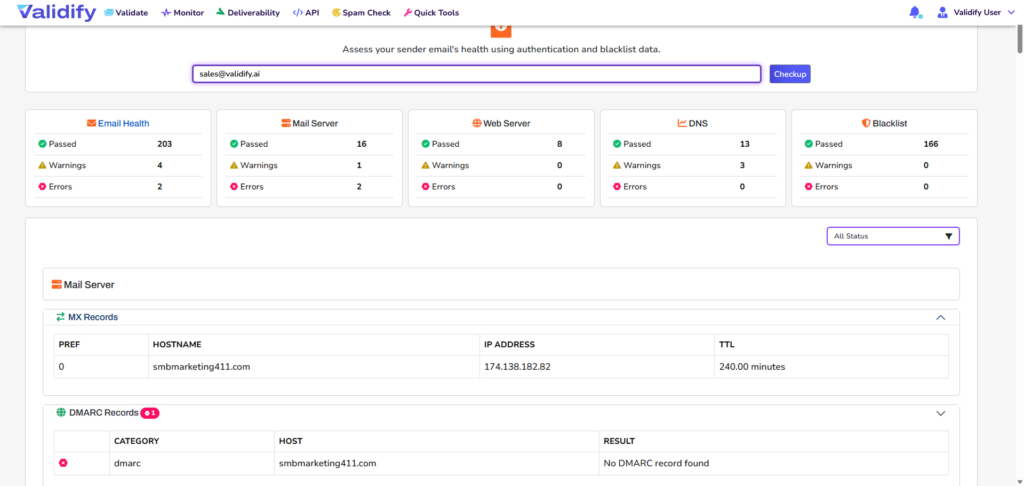
We bridge this gap by offering a suite of tools that not only confirm email validity but also monitor and diagnose issues that lead to poor inbox placement, thus helping prevent valid emails going to spam.
How Validify Contributes to Better Deliverability:
- Superior Email Validation: Our core service rigorously checks for syntax errors, domain existence, MX records, role-based emails, disposable addresses, and spam traps. By removing unmailable addresses from your list, we immediately reduce your bounce rate, which is a critical factor in maintaining a healthy sender reputation. This proactive cleaning is your first line of defense against being flagged by ISPs.
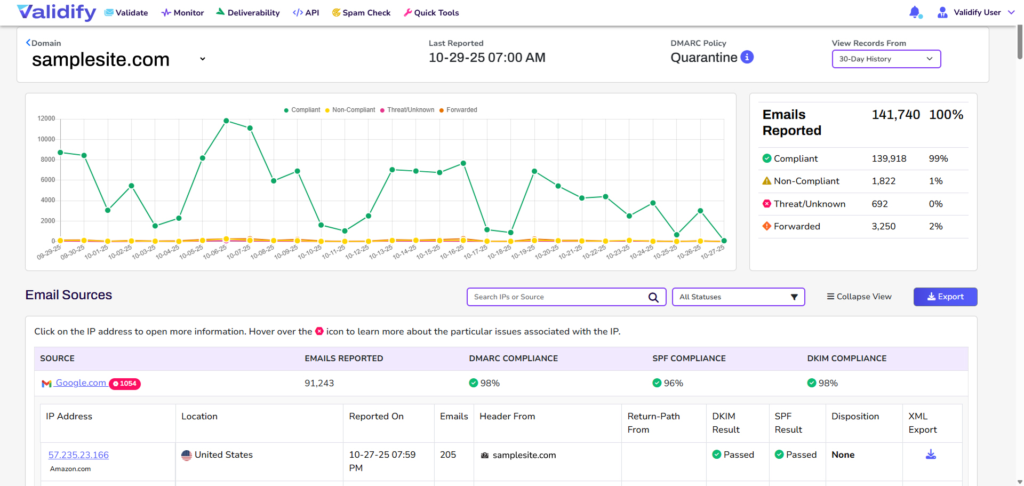
- Real-Time Email Health Monitoring: We don’t just validate once; we equip you with insights to maintain ongoing email health. This includes monitoring for potential deliverability issues that can arise even after initial validation. While we don’t directly offer DMARC monitoring, our platform contributes to the overall health that DMARC reports reflect, by ensuring your source data is clean.
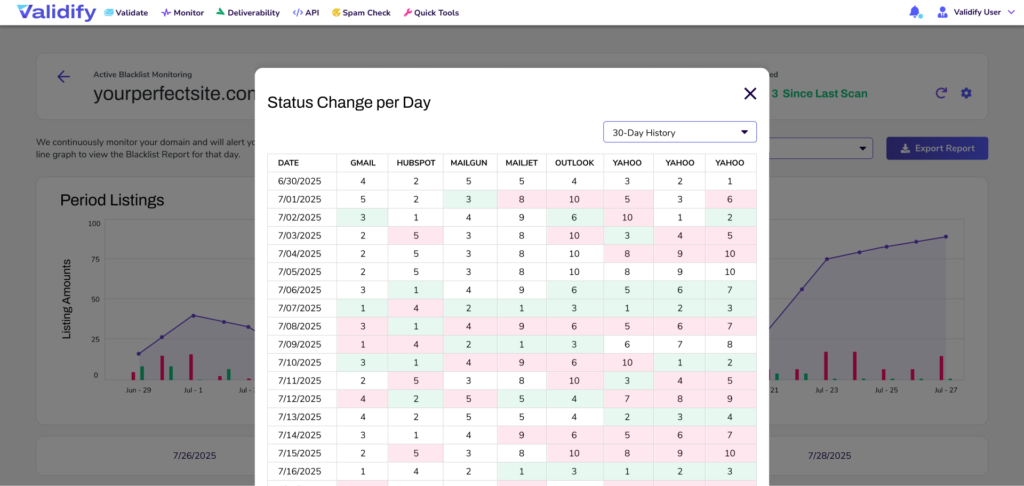
- Blacklist Monitoring: Validify includes tools to monitor if your sending IP addresses or domains have been listed on major industry blacklists. Being blacklisted is a clear sign that your emails will be routed to spam or outright rejected. Prompt notification allows you to take immediate action, often in collaboration with your Email Service Provider (ESP), to resolve the issue and protect your sender reputation.
- Spam Trap Prevention: Our validation process is particularly effective at identifying and removing known spam traps. Sending to spam traps is catastrophic for deliverability. By keeping them off your list, Validify helps prevent a significant source of reputation damage.
- Data Quality Improvement: Beyond just validity, we enhance overall data quality. Cleaner lists mean more targeted communication, leading to higher engagement rates. Engaged recipients are less likely to mark emails as spam, thus fostering a positive feedback loop with ISPs.
Addressing the “Why Valid Emails Go to Spam” Challenge:
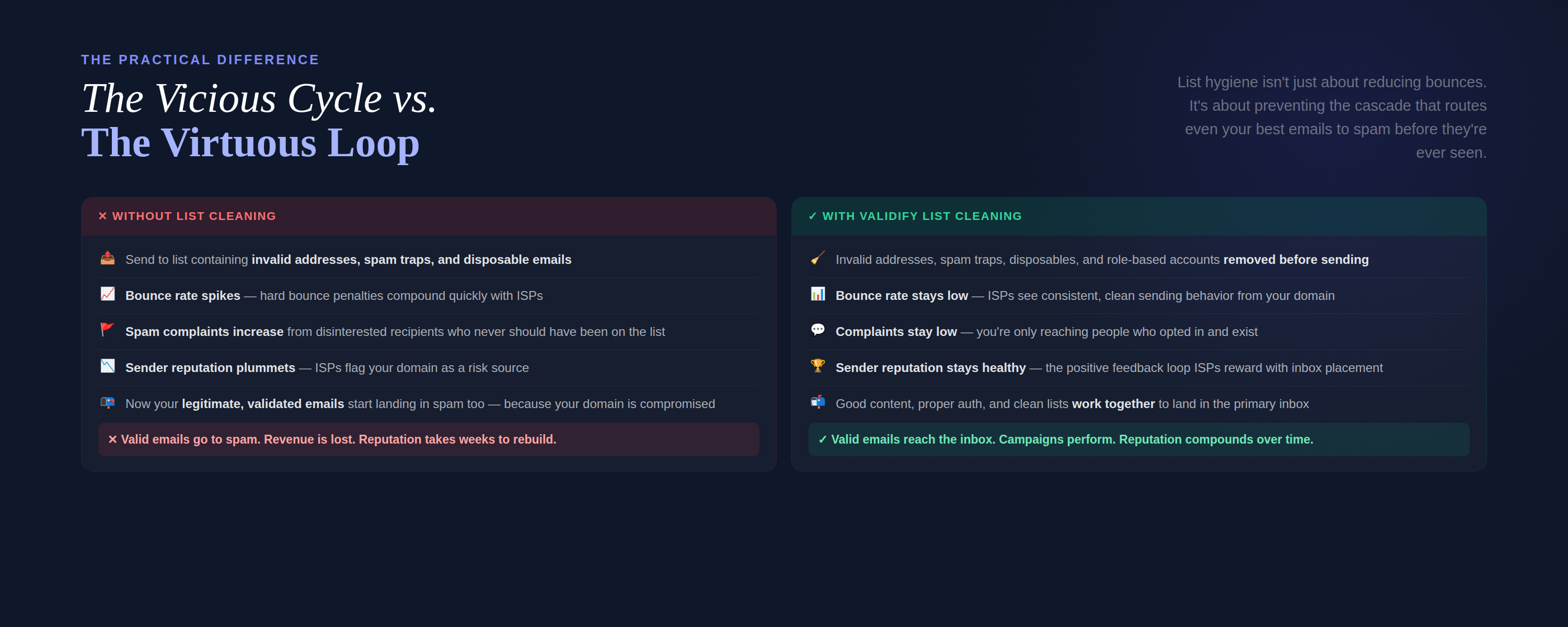
Validify acts as an essential diagnostic and preventative tool. Consider the following scenario:
- Without Validify: You send emails to a list containing invalid addresses, spam traps, and disposable emails. Your bounce rate spikes, spam complaints increase from disinterested recipients, and your sender reputation plummets. Your legitimate, validated emails then start going to spam because your overall sending health is compromised.
- With Validify: You clean your list before sending. Invalid addresses are removed, spam traps are avoided. Your bounce rate is low. This foundational health allows your good content and proper authentication (SPF, DKIM, DMARC, not direct Validify features but crucial complements) to shine, significantly improving the chances that your valid emails reach the primary inbox.
| Feature | Validify’s Role (Direct/Indirect) | Impact on “Valid Emails Going to Spam” |
|---|---|---|
| Email Validation | Direct: Core service for syntax, domain, MX, mailbox checks. | High: Prevents hard bounces, spam traps, disposable emails, which are foundational to good sender reputation. |
| Blacklist Monitoring | Direct: Alerts if IP/domain is blacklisted. | High: Early detection and remediation of severe reputation damage. |
| Spam Trap Detection | Direct: Identifies and flags spam trap addresses. | High: Prevents catastrophic reputation damage from traps. |
| Recipient Engagement | Indirect: Facilitates by providing clean, targeted lists. | High: Clean lists lead to better engagement, reducing spam complaints. |
| Sender Authentication | Indirect: Not a direct feature, but crucial for deliverability. | High: Validify ensures a clean foundation for these protocols to be effective. |
| Content Quality | Indirect: No content analysis, but good lists incentivize better content. | Moderate: Focusing on quality lists often leads to better content strategies. |
| DMARC Monitoring | Indirect: Not a direct feature, but a healthy list supports positive DMARC reports. | Moderate: DMARC reports reflect sending health, which Validify improves. |
Validify provides the crucial first layer of defense and ongoing vigilance against the degradation of your email health. By ensuring the fundamental validity and cleanliness of your email lists, we empower marketers to focus on content and engagement, confident that their efforts are not undermined by preventable deliverability issues. It’s about ensuring your valid emails have the best possible chance of reaching their intended destination – the primary inbox.
Proactive Strategies to Prevent Valid Emails from Landing in Spam
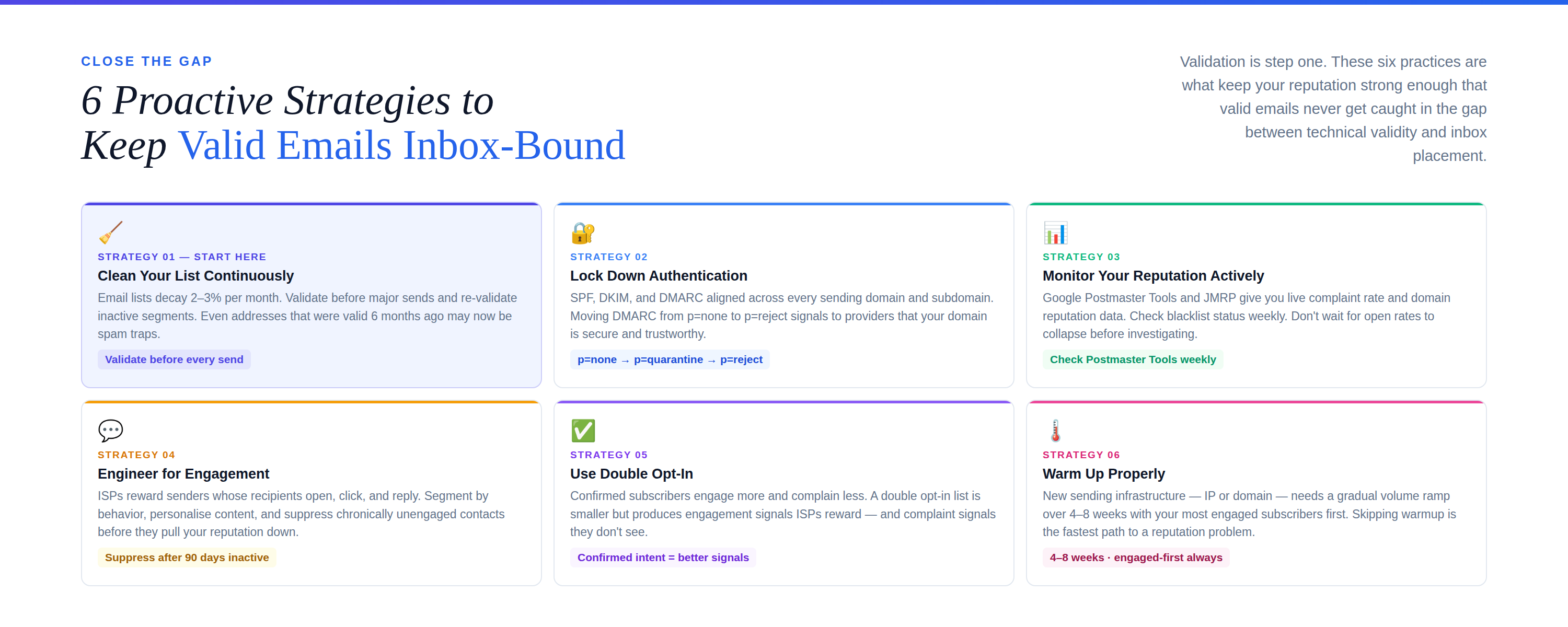
Successfully navigating the complexities of email deliverability requires a multifaceted approach that extends beyond initial email validation. It demands continuous effort in maintaining a positive sender reputation, crafting engaging content, and optimizing your technical infrastructure. By implementing these proactive strategies, you can significantly reduce the likelihood of valid emails going to spam.
1. Nurture Your Sender Reputation Diligently
Your sender reputation is your most valuable asset in email marketing. Protect and enhance it with these practices:
- Monitor Blacklists Regularly: Use tools like Validify’s blacklist monitoring to stay informed. If you find your IP or domain listed, act immediately to identify the cause and request removal.
- Maintain Low Bounce Rates: This is where comprehensive email validation, like Validify’s service, shines. Regularly clean your list to remove invalid, inactive, and risky addresses before sending. Even valid emails can become invalid over time as users change jobs or abandon accounts.
- Encourage Engagement: Design emails that recipients want to open and click. Personalized content, clear calls to action, and valuable offers all contribute to positive engagement signals. Monitor your open rates and click-through rates (CTRs) closely.
- Handle Spam Complaints Promptly: If using a feedback loop (FBL) service, process complaint reports swiftly. Immediately remove subscribers who complain from your list. High complaint rates are a major red flag for ISPs.
- Implement Sender Authentication (SPF, DKIM, DMARC): Ensure these protocols are correctly set up for all your sending domains. They verify your identity and help receiving servers trust your emails. Validify, while not providing DMARC monitoring directly, complements its effectiveness by improving your foundational email health.
- Warm Up New Sending IPs/Domains: If you’re using a new IP address or domain for sending, start with small volumes and gradually increase them. This builds a positive sending history with ISPs.
2. Craft Compelling and Deliverable Content
The content of your email is a major factor in how ISPs perceive your message and how recipients react to it.
- Avoid Spam Trigger Words and Phrases: Be mindful of overly promotional language, excessive capitalization, and exclamation points. Focus on value, not hyperbole.
- Maintain a Healthy Text-to-Image Ratio: Emails that are largely image-based with minimal text can trigger spam filters. Aim for a good balance, ensuring key messages are conveyed in text.
- Optimize Subject Lines: Make them concise, descriptive, and engaging without being misleading. Personalization in the subject line can significantly boost open rates.
- Ensure Clean HTML: Use standard, well-formatted HTML. Avoid using code generated by word processors that can be bloated or problematic. Test your email rendering across various clients.
- Use Reputable Links: Ensure all links in your email lead to legitimate, secure websites (HTTPS). Avoid excessive link shorteners if possible, as they can sometimes be associated with spam.
- Provide a Clear Unsubscribe Option: A prominent and easy-to-use unsubscribe link is legally required and essential for managing your list health. Making it difficult leads to spam complaints.
3. Optimize Your Email Infrastructure and List Management
Robust technical setup and smart list management are critical for consistent inbox placement.
- Segment Your Audience: Send targeted content to different segments of your list based on demographics, behavior, or interests. This increases relevance and engagement.
- Implement Double Opt-in: Require subscribers to confirm their subscription via email. This verifies the address’s validity and ensures genuine interest, leading to higher engagement and fewer complaints.
- Regularly Clean Your Email List: Beyond initial validation, email lists degrade over time. Implement a re-engagement strategy for inactive subscribers and remove those who remain unengaged. Validify’s ongoing monitoring can assist in identifying potential issues.
- Monitor Your Deliverability Metrics: Keep a close eye on your open rates, click-through rates, bounce rates, and spam complaint rates. Tools offered by your ESP or third-party deliverability platforms can provide these insights.
- Test Your Emails Before Sending: Use email spam checkers and preview tools to see how your email looks and scores before it goes out. This can catch potential issues before they impact your campaign.
- Consider a Dedicated IP (for high volume senders): While more responsibility, a dedicated IP gives you full control over your sending reputation, separating you from the sending habits of others.
By diligently applying these proactive strategies in conjunction with robust email validation services like Validify, you create a powerful defense against the problem of valid emails going to spam. It’s an ongoing commitment, but one that directly translates to improved campaign performance, stronger brand trust, and ultimately, better ROI from your email marketing efforts.
The Financial and Reputational Costs of Ignoring the Deliverability Gap
The consequences of valid emails consistently landing in spam extend far beyond mere inconvenience. For businesses, ignoring the reputation gap between email validation and actual inbox placement can lead to substantial financial losses and severe, long-term damage to brand reputation. Understanding these costs underscores the importance of a comprehensive deliverability strategy that includes robust tools like Validify.
Financial Losses: The Hidden Drain on Your Marketing Budget
- Wasted Marketing Spend: Every email sent to a spam folder is a wasted resource. You’ve invested in list acquisition, content creation, email platform fees, and potentially even validation, only for your message to be unseen. This directly impacts your marketing ROI, turning potential revenue into sunk costs.
- Lost Sales and Conversions: If your promotional emails, abandoned cart reminders, or transactional notifications end up in spam, customers won’t see them. This directly translates to missed sales opportunities, reduced lead generation, and lower conversion rates, affecting your bottom line.
- Decreased Customer Lifetime Value (CLV): Consistent deliverability issues erode customer trust and engagement. If customers rarely receive your communications, they are less likely to remain loyal, repurchase, or advocate for your brand. Over time, this decreases their overall lifetime value.
- Higher ESP Costs: Some Email Service Providers (ESPs) charge based on the number of emails sent or active subscribers. If a significant portion of your list is leading to spam folders, you’re paying to send messages that aren’t being seen, inflating your operational costs without commensurate returns.
- Re-engagement Campaign Expenses: When deliverability falters, businesses often resort to costly re-engagement campaigns or alternative marketing channels to reach their audience, adding further expenses that could have been avoided with proactive deliverability management.
Reputational Damage: Erosion of Trust and Brand Authority
- Damaged Sender Reputation: This is a vicious cycle. The more your emails land in spam, the worse your sender reputation becomes. ISPs use these negative signals to filter even more of your future emails, making it increasingly difficult to reach the inbox. Rebuilding a damaged reputation is a lengthy and arduous process.
- Loss of Customer Trust: When customers sign up for your emails, they expect to receive them. If they repeatedly find your messages in spam or don’t receive them at all, they may perceive your brand as unreliable, unprofessional, or even a purveyor of spam. This erodes trust.
- Brand Devaluation: A brand associated with spam or poor email practices can suffer significant devaluation. Consumers are increasingly wary of unsolicited or unwanted communications, and being perceived as a spammer can severely tarnish your brand image.
- Reduced Brand Visibility and Authority: If your emails consistently fail to reach the inbox, your brand’s presence in a crucial communication channel diminishes. This reduces your ability to communicate effectively with your audience, share updates, and establish authority in your industry.
- Negative Feedback and Social Media Backlash: Frustrated recipients might complain directly to your customer service, or worse, voice their dissatisfaction on social media, further damaging your public image. This can lead to a viral spread of negative sentiment that is hard to control.
Consider a case study where a prominent e-commerce brand saw a 15% drop in email-driven revenue over three months due to a gradual increase in their valid emails going to spam. This wasn’t due to a sudden blacklist, but a slow decline in engagement leading to higher spam filtering. After implementing comprehensive list cleaning with a tool similar to Validify, alongside a re-engagement strategy and DMARC monitoring, they recovered 12% of that lost revenue within six months, demonstrating the tangible impact of proactive deliverability management.
By investing in preventative measures like advanced email validation and deliverability monitoring provided by Validify, businesses can proactively protect their financial interests and preserve their invaluable brand reputation. It’s not just about sending emails; it’s about ensuring they are received and valued.
Conclusion: Mastering Deliverability in a Complex Email Landscape
The journey of an email from sender to recipient’s inbox is far more intricate than simply having a valid address. The distinction between an email that can be delivered and one that will be delivered to the primary inbox defines the reputation gap – a critical, often-overlooked challenge in email marketing. As we’ve explored, valid emails going to spam is a multifaceted problem stemming from sender reputation, content quality, infrastructure configuration, and even recipient-specific factors.
Ignoring this gap carries significant financial and reputational costs, turning marketing investments into missed opportunities and eroding brand trust. However, by adopting a proactive, comprehensive strategy, businesses can effectively navigate this complex landscape.
Key Takeaways for Mastering Deliverability:
- Email validation is foundational, but not exhaustive: Tools like Validify provide the essential first step by ensuring your list is free of invalid, risky, and spam trap addresses, directly impacting bounce rates and preventing immediate reputation damage.
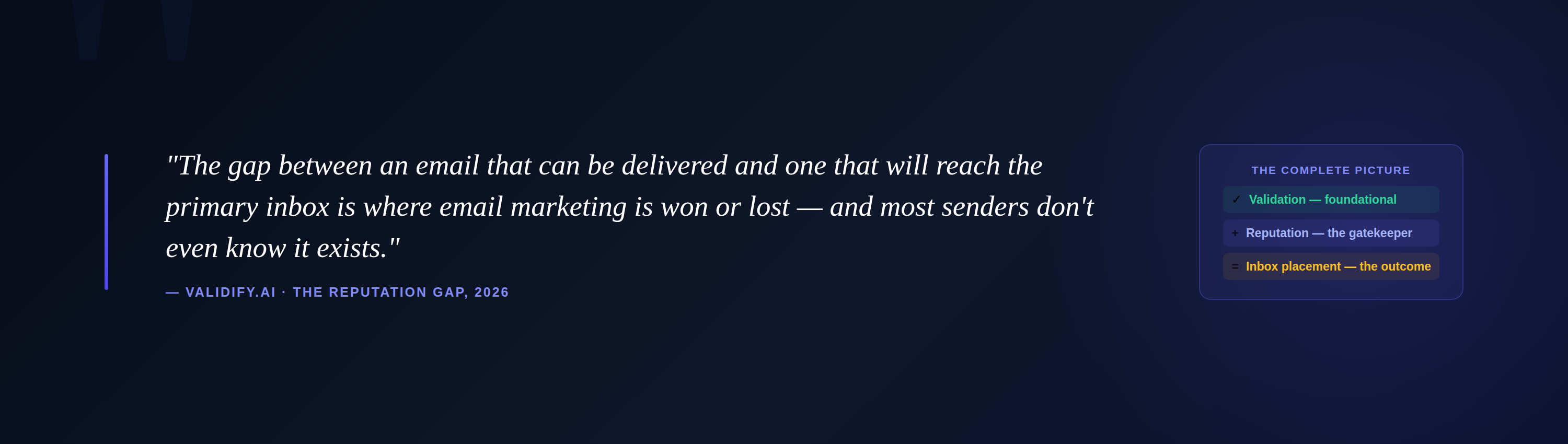
- Sender reputation is paramount: A positive reputation, built on consistent engagement, low complaints, proper authentication (SPF, DKIM, DMARC), and proactive blacklist monitoring, is the gatekeeper to the inbox.
- Content and infrastructure matter: Crafting engaging, spam-filter-friendly content and maintaining a robust, well-configured sending infrastructure are non-negotiable for successful deliverability.
- Ongoing vigilance is key: The email ecosystem is dynamic. Continuous monitoring, regular list hygiene, and adaptation to evolving ISP algorithms are crucial for sustained inbox placement.
Validify empowers businesses by providing the preventative and diagnostic tools necessary to build and maintain a healthy email sending environment. By starting with a meticulously cleaned and validated list, you establish a strong foundation that amplifies the effectiveness of all your other deliverability efforts. This proactive approach not only prevents valid emails from going to spam but also ensures your message resonates with your audience, drives engagement, and contributes directly to your campaign success and overall marketing ROI. Embrace a holistic deliverability strategy, and transform your email marketing into a powerful, reliable channel.
Ready to ensure your valid emails always reach the inbox?
Visit Validify.ai today to explore our AI-powered email validation and monitoring solutions and start bridging your deliverability gap!
Frequently asked questions
What is the difference between email validation and email deliverability?
Email validation confirms an address is technically correct and exists, preventing hard bounces. Email deliverability refers to the ability of an email to successfully reach the recipient’s primary inbox, influenced by factors like sender reputation, content, and infrastructure. Validation is a prerequisite for good deliverability, but not a guarantee.
Why would an email that passed validation still go to spam?
Even validated emails can land in spam due to poor sender reputation (high complaints, low engagement), spammy content, lack of proper sender authentication (SPF, DKIM, DMARC), being on a blacklist, or sending to spam traps not initially detected or newly created.
What is sender reputation and why is it so important?
Sender reputation is a score ISPs assign to your sending IP and domain based on past sending behavior. It’s crucial because a low score signals untrustworthiness, leading ISPs to filter your emails to spam or block them entirely, regardless of the email’s validity or content.
How does Validify help prevent valid emails from going to spam?
Validify ensures foundational email health by removing invalid addresses, identifying spam traps, and monitoring blacklists. By reducing bounce rates and preventing reputation-damaging sends, Validify helps build a strong sender reputation, allowing your legitimate, validated emails a much higher chance of reaching the inbox.
What are some immediate steps I can take to improve my deliverability?
Immediately clean your email list with a service like Validify, ensure proper sender authentication (SPF, DKIM, DMARC), monitor your sender reputation, maintain engaging content, provide clear unsubscribe options, and regularly check for blacklist status to improve deliverability.
Can email content alone cause valid emails to go to spam?
Yes, even with a perfect sender reputation, email content can trigger spam filters. Overuse of spammy keywords, poor HTML formatting, suspicious links, excessive images, or misleading subject lines can all cause an otherwise valid email to be classified as spam by receiving servers.